Mysuru Sugarcane Growers Storm Deputy Commissioner Office Demanding Higher FRP and State Advisory Prices
Hundreds of sugarcane farmers staged a fierce protest outside the Mysuru Deputy Commissioner's office, demanding a sharp hike in the Fair and Remunerative Price and a competitive State Advisory Price. The agitation highlights growing agrarian distress and mounting pressure on both federal and state administrations to revise crop valuation metrics.

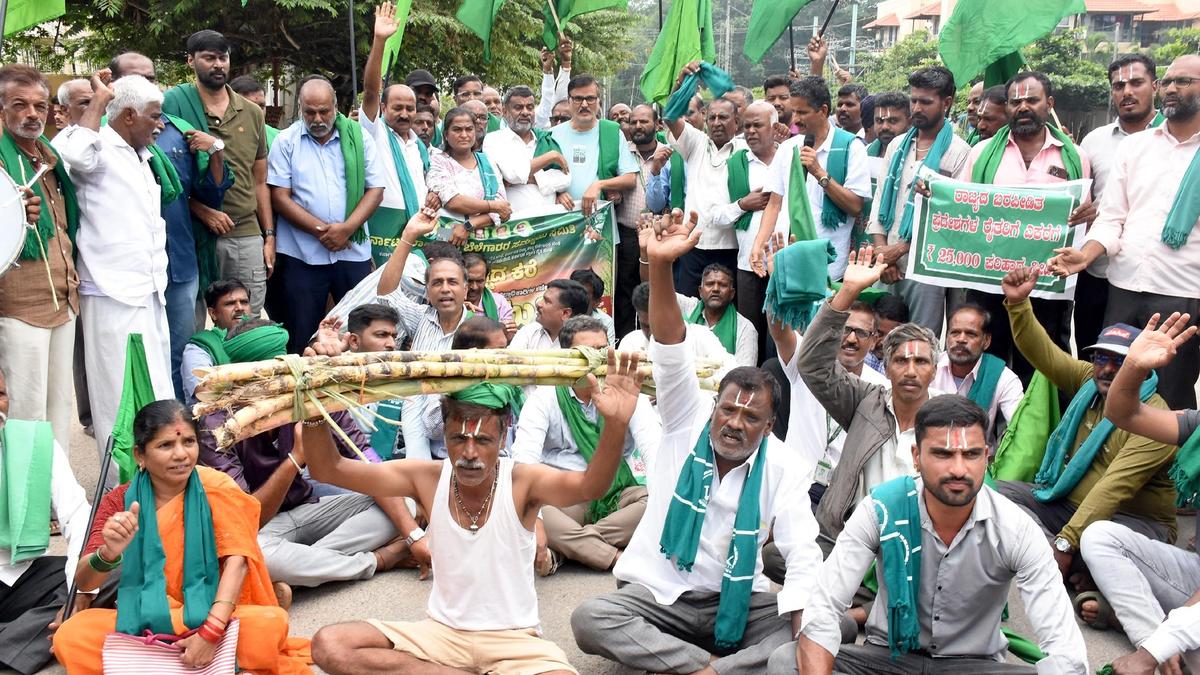
- Protesting growers demanded the central government elevate the Fair and Remunerative Price to ₹4,500 per tonne.
- Farmers urged the Karnataka administration to introduce a State Advisory Price comparable to policies in neighboring states.
- The demonstrations disrupted local traffic and brought heightened attention to the ongoing sugarcane pricing dispute.
MYSURU — Tensions escalated sharply in front of the Deputy Commissioner's office in Mysuru as a massive contingent of sugarcane cultivators converged to stage an aggressive siege, demanding immediate financial revisions from both state and federal administrations. The mobilization, which drew hundreds of agriculturists from across the district, paralyzed administrative access points and prompted a heavy police deployment to maintain order.
At the core of the confrontation is a deep-seated grievance regarding current crop valuation frameworks, which growers argue fail to cover escalating cultivation costs. The protesting unions have pressed the central government to substantially elevate the Fair and Remunerative Price to ₹4,500 per tonne, specifically pegged against a 10.25 percent recovery rate. Simultaneously, the agrarian leaders have strongly urged the Karnataka government to institute a dedicated State Advisory Price, mirroring successful policy models currently adopted in states like Tamil Nadu, Punjab, and Uttar Pradesh.
According to detailed reporting from The Hindu, union representatives voiced intense frustration over the perceived apathy of policymakers toward the mounting debts facing agrarian households. Speakers at the demonstration emphasized that despite repeated memorandums and dialogue sessions, regional authorities have delayed implementing robust protective pricing structures, forcing cultivators to resort to direct-action tactics to amplify their financial demands.